

Sourcing guide
Eco Friendly Earplugs: What a Material Sheet Can Prove
Eco friendly earplugs can mean recycled content, biodegradability, plastic-free packing or reuse. Only the last is recorded here, and it decides the SKUs.
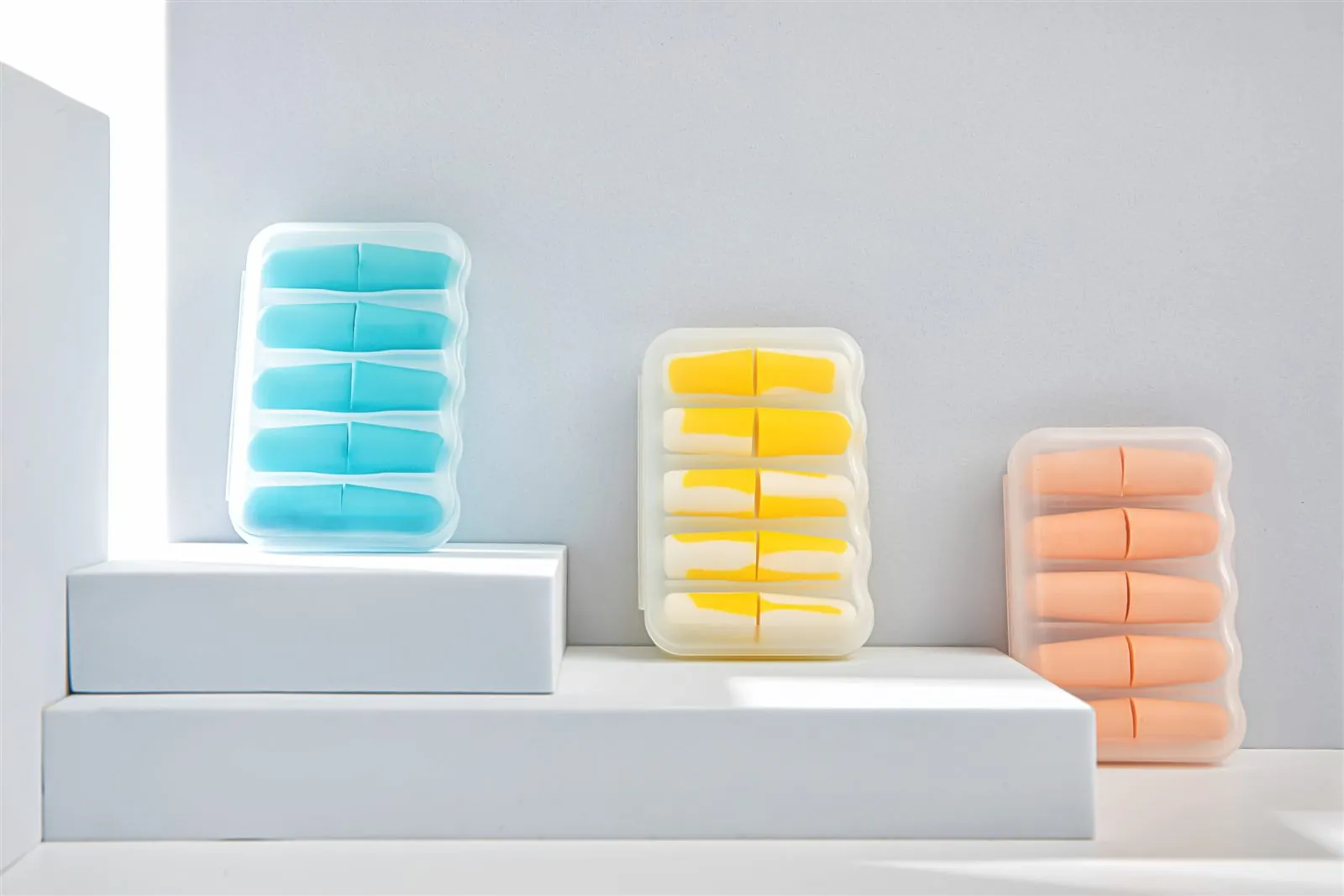
Six materials, two end-of-life paths
Most of the 28 SKUs in this catalogue record a material line, and between them they cover PU foam, natural wax with medical-grade cotton, conventional and fully fumed silicone, soft silicone, soft silicone gel, liquid silicone rubber, TPE, and ABS on the earmuffs.
Sort those by what happens after the first wear and the list collapses into two groups. Foam and the wax-cotton capsule are consumed by use - one pair, one period of wear. Silicone in its several forms, TPE and ABS are not. That is the only structural difference the sheets support, and it is the foundation every defensible environmental claim on this range has to stand on.
What the phrase can and cannot cover
The phrase eco friendly earplugs covers at least four separate claims: recycled content, biodegradability, plastic-free packaging, and reuse. Only the fourth can be answered from the attribute sheets, because it is the only one that follows from the material name.
Nothing in the catalogue records recycled or bio-based content, compostability, or a test method for either. So a brief that says eco friendly ear plug and nothing else cannot be quoted from the page - it has to be turned into a question with a number in it, and answered by the factory in writing. Packaging is the same problem: the sheets name a jar, a box, an aluminium bottle and a plastic box, and specify the material of none of them.
What can be stated is narrower and more useful: which SKUs are reusable, what they are made of, and what still has to be verified before a claim goes on a pack. On this catalogue that is a silicone-and-TPE story, with the foam and wax lines positioned as consumables rather than as environmental products.
TPE, TPR and the name on the PO
A request for tpr earplugs lands on two SKUs here, SA-2-14 and SA-2-15, because those are the only products whose material line reads TPE, and no SKU in the catalogue records TPR by name. TPR is a subset of the thermoplastic elastomer family rather than a separate material, but the sheets only carry the broader word.
The distinction matters at documentation level, not at the ear. Both SKUs record 23 dB, filter colours of black, orange, green and blue, and both inherit the filtered family terms: 100 pairs minimum, customisation from 10,000 pairs, one pair in an aluminium bottle, and a 42 x 35 x 44 cm carton at 9.0 kg gross.
So the specification has to match the sheet. If the PO says TPR and the sheet says TPE, the material declaration and the artwork can end up describing two different things, and neither document resolves it. Use the sheet's word, then ask whether the grade behind it supports the claim you intend to print.
Where reuse is a real range, and where it is not
If a range is sold as washable ear plugs sleeping, it can only be built from the silicone lines here, because the foam family is consumed by wear rather than cleaned between wears. The reusable sleep options are SA-5-2 in soft silicone gel at 27 dB across four sizes, SA-1-17 at 27 dB, SA-1-3 at 29 dB, and SA-2-18F in soft silicone at 21 dB.
For silicone ear protection sleeping, that is four rated SKUs between 21 and 29 dB, plus SA-2-17, which records no SNR at all. Minimum orders split the group in two: SA-5-2, SA-1-17, SA-2-17 and SA-2-18F start at 100 pairs, while SA-1-3 and SA-1-7AP start at 2,000. A reusable range can therefore be tested at 100 pairs, which is not true of the foam line at 2,000.
The caveat is that no sheet records a wash test, a cycle count or a cleaning instruction. Reusable is a material property here, not a tested claim, and a retail pack that says more than that needs factory data behind it.
Soft silicone, silicon, and the spelling on the brief
A brief for soft silicon ear protection points at the two soft silicone SKUs - SA-5-2 and SA-2-18F - rather than at foam or at the firmer silicone lines. The sheets spell it silicone, and that is the spelling to carry onto the PO and onto the artwork.
The two are not interchangeable. SA-5-2 is a 2.5 g gel capsule in four recorded sizes at 27 dB, customisable from 50 kg. SA-2-18F is a 21 dB plug in green, blue or purple, packed in a retail box of 8.5 x 8.5 x 3 cm at 21.5 g, 200 sets to a carton of 29 x 33 x 23 cm. One is bought as a size run; the other is a single retail unit.
That is the pattern across the whole subject: the environmental question is really a material question, and the material question is answered SKU by SKU. There is no family-level answer to give a buyer, and no sheet that supplies one.
Six questions that turn a claim into a spec
Whichever way the range is positioned, these are the six lines that separate a claim from a specification:
- Which claim is being made - recycled content, biodegradability, plastic-free packing or reuse
- Which SKU carries it, because the material line changes within a family
- The exact material word on the sheet, before any synonym reaches the artwork
- Whether the factory holds test data for the claim, and in which document it is issued
- Packaging material, which the sheets name but do not specify
- Whether the product is sold as reusable, and if so what cleaning instruction ships with it
Only the second and third can be answered from this page. The rest are factory questions, and on an environmental claim they are the difference between a positioning line and a liability.