

Industry note
Hunting Earplugs: What the Sheet Says Before You Specify
No hunting SKU exists in this catalogue. Hunting earplugs are assembled from passive lines, and the sheet decides which: 38 dB foam, 31 dB earmuffs, or filters.
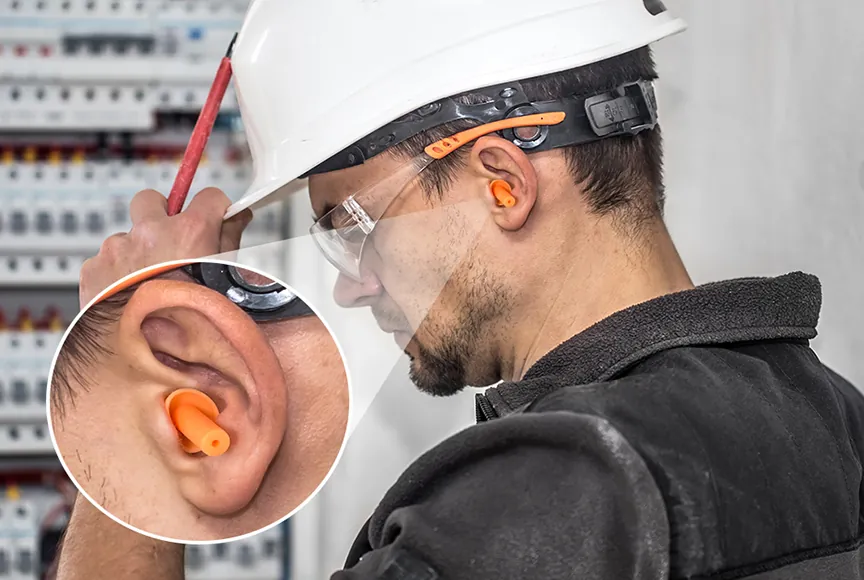
No hunting SKU, and that is the first fact
Six families cover this catalogue, and their application rows read sleeping, travel, industry, concert, motorcycle, swim, bath, shower, baby sleep and weeding. Hunting and shooting appear nowhere. There are 28 SKUs and not one of them is a field-sports line.
Search language is looser than the catalogue - earplugs hunting, hunting earplugs, shooting plugs - but the buying decision is narrower than the language. It comes down to which recorded attenuation band suits the buyer's market, and whether the range is sold as a consumable or as a reusable unit.
Three attenuation bands, and what sits in each
The top of the range is PU foam. SA-7-3 records 38 dB at 14 x 26 mm for adults with long ear canals, and SA-7-5 records 38 dB at 13 x 24 mm. Below them, SA-7-2 at 36 dB (12.3 x 20 mm) and SA-7-4 at 36 dB (17 x 25 mm). All four are the same material and the same carton family, differentiated by size and target user.
The 31 dB band is where the reusable options start: SA-2-4, a filter plug in liquid silicone rubber with three recorded values of 20, 24 and 31 dB, and SA-8-11, a passive earmuff in black, fluorescent orange or fluorescent lemon. SA-1-8, the airplane plug, records 32 dB.
Below that the filter line runs from 9 to 27 dB. SA-2-2 alone records five settings - 9, 15, 18, 25 and 27 - which is a range for keeping some sound, not for shutting it out. A field-sports brief that asks for maximum attenuation and a brief that asks for conversation are two different SKUs from the same family.
Foam or filter: the difference is the order, not the ear
Ear protection foam is a consumable line: 2,000-pair minimum, customisation from 30,000 pairs, 60 pairs per jar, or 5 or 1 pair per box, in orange, blue, green and yellow. A filter plug is a reusable line: 100-pair minimum, customisation from 10,000 pairs, 1 pair in an aluminium bottle.
That gap sets the business model more than it sets the acoustics. A foam line sells repeat boxes into a club, a range or a retail shelf. A filter line sells one unit that lasts a season and comes back for a replacement, not for a refill.
One caution sits inside the foam numbers. SA-7-3 is the highest recorded figure at 38 dB and also the narrowest fit note in the family - adults with long ear canals. A range built only from the loudest number will fit the fewest people, and the sheet says so plainly.
What a shooting season asks that the sheet cannot answer
Every value in this catalogue is a single SNR. There is no NRR, no impulse or peak measurement, and no test standard named against any figure. There is also no lead time, no field-sports packaging and no accessory in any SKU row.
That matters because impulse noise is the reason the category exists. A buyer who prints 38 dB on a pack is repeating a page, not a test report, unless the factory supplies the method behind the number. The same applies to earplugs protection claims in general: the sheet records attenuation, and attenuation is one line of a much longer document.
So the range is best sold on what is verifiable - material, size, target user, pack, minimum - and the acoustic claim is held to the recorded SNR until the factory issues more.
The RFQ, in five lines
A field-sports enquiry is short if it is written properly. These are the five lines that decide the quote:
- Which band: 38, 36 or 31 dB, and whether the fit note matches the ear the market is selling to
- Whether an impulse-noise figure exists for the SKU, and in which document it is issued
- Foam or reusable, because the minimums are 2,000 pairs against 100
- Pack: a jar of 60, a 1-pair box, or the aluminium bottle
- Carton count at order size, and whether the colour set is a stock colour or a customisation
Two of those five are answered on this page. The other three decide whether a season ships on time, and they belong in writing before the PO.