

Sourcing guide
Individually Wrapped Ear Plugs: Pack Formats That Ship
Individually wrapped ear plugs, tubes, canisters and keychains are four pack questions. The sheets answer half of them, and the carton maths moves first.
The pack lines the sheets actually record
Every family carries a packaging row, and between them they describe five formats. The foam line packs 60 pairs per jar, 5 pairs per box or 1 pair per box. The filter line puts 1 pair in an aluminium bottle. The silicone family defaults to 1 pair in a plastic box. The mouldable family packs 6, 10 or 12 pieces per box. SA-2-18F is the only SKU with a measured retail box: 8.5 x 8.5 x 3 cm at 21.5 g, 200 sets to a carton of 29 x 33 x 23 cm.
Each of those rows ends with the same four words, or to your requirements. That is the only place in the attribute document where a buyer's own specification is invited, and it sits on packaging rather than on the product. Which is why pack format is the cheapest thing on this range to change - and the easiest to under-cost.
What individually wrapped ear plugs change first
Pair-level packing is a count decision, not a product decision, and it moves the carton before it moves anything else. A jar holds 60 pairs. Converting the same run to 1-pair boxes turns a 2,000-pair minimum into 2,000 retail units, and the foam carton at 42 x 35 x 44 cm and 9.0 kg gross no longer describes the same shipment.
SA-2-18F shows the other end of the scale: 200 retail sets to a carton of 29 x 33 x 23 cm at 4.8 kg. That carton is small enough to ship as a shelf-ready unit, which is a different commercial object from the 60-set baby earmuff carton at 9.2 kg or the 24-set at 4.6 kg.
What none of the sheets record is the wrap itself. There is no film, foil or paper specification, no barrier property, no print area and no shelf life. An individually wrapped ear plugs claim is therefore a packaging line item with nothing behind it on the page, and the material has to come from the factory in writing.
Tubes, canisters and containers: three words, one gap
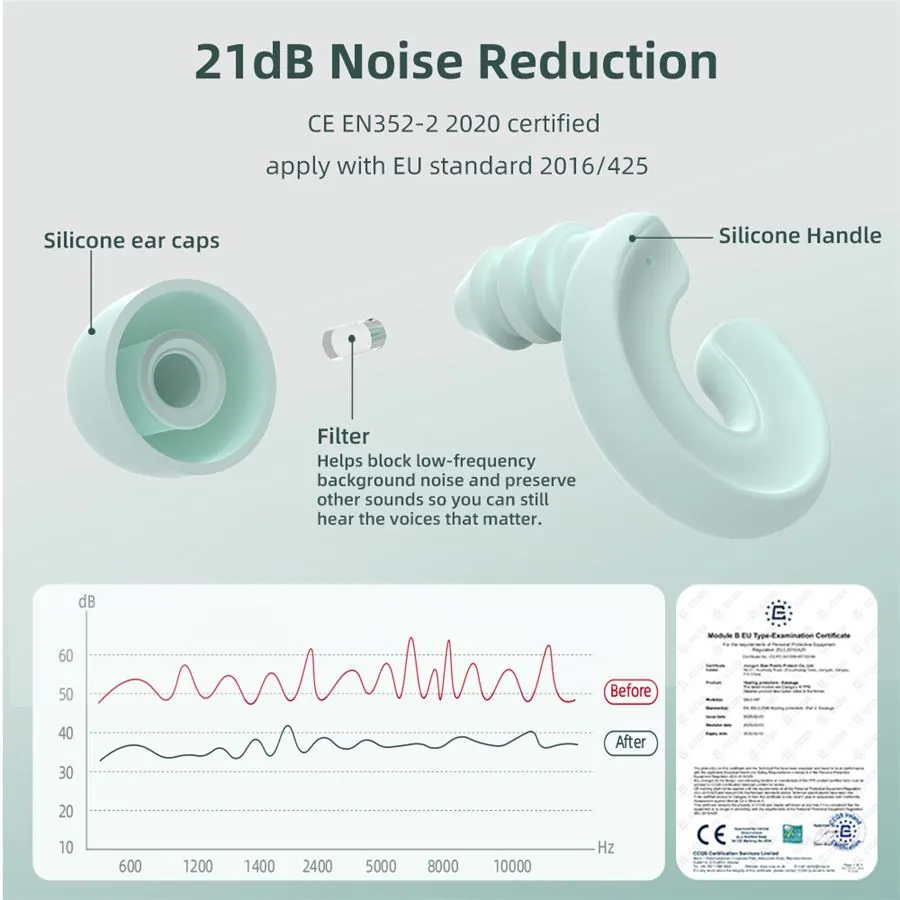
No SKU in the catalogue records a tube. The nearest recorded format is the aluminium bottle on the filter line - 1 pair per bottle, 100 pairs minimum, 10,000 pairs for customisation, 42 x 35 x 44 cm carton at 9.0 kg. When a brief asks for earplugs with canister, that bottle is the only format in the document that matches: a rigid container the buyer keeps rather than a film the buyer throws away.
The earplug container is the vaguest of the three words. It can mean the retail box, the jar, or a separate carry case, and the sheets use jar, box, bottle and plastic box, never case. No SKU lists an accessory either, so a request for a case is a request for an item that is not in the catalogue.
The ear plug tube sits in the same place. A tube implies a rigid cylinder with a cap and a defined inner diameter; the sheets describe a bottle, a box and a jar, and none of them as a tube. The distinction costs nothing to raise at the brief and is expensive to discover after the artwork is approved.
Keychains, clips and the volume anchor
An ear plug keychain is a promotional format rather than a hearing-protection format. The plug underneath is a catalogue SKU; the case, the clip and the attachment are new parts, and nothing in the attribute sheets records a case, a clip, a chain or a printed logo field.
The only volumes the document gives for changing anything are the Customisation rows: 500 sets on the earmuffs, 100 pairs on the filter and moulded families, 2,000 pairs on the silicone default, 30,000 on foam, and 50 kg on SA-5-2. A keychain project has to be sized against whichever of those applies to the SKU underneath it, not against the promotional budget.
That is why promotional packs in this range usually land on the filter line. It opens at 100 pairs, customises from 10,000, and already ships in a rigid aluminium bottle, so the pack development is a print job rather than a tooling job. A foam keychain is the opposite: cheap unit, 30,000-pair threshold.
A pack specification, in the order it gets decided
Pack decisions cascade, and getting the order wrong is what turns a cheap format into an expensive shipment:
- Product and family first, because the pack options belong to the family and not to the buyer's artwork
- Pairs per retail unit: 1, 5, 6, 10, 12 or 60 are the counts the sheets actually record
- Retail unit material and print area, neither of which is recorded anywhere in the catalogue
- Carton count and gross weight, which change with every pack decision above
- Whether the pack is a container the buyer keeps or a film the buyer discards
- Whether anything printed on the pack is a claim that needs factory evidence
The first two lines can be answered from this page. The rest decide the freight, and freight is where a cheap pack stops being cheap.