

Sourcing guide
Wholesale Industrial Earplugs & Earmuffs: MOQ, SNR, Freight
Three SKUs cover industrial use: a 31 dB earmuff, a 38 dB foam plug and a 29 dB flanged silicone plug. Their minimum orders differ by a factor of forty.
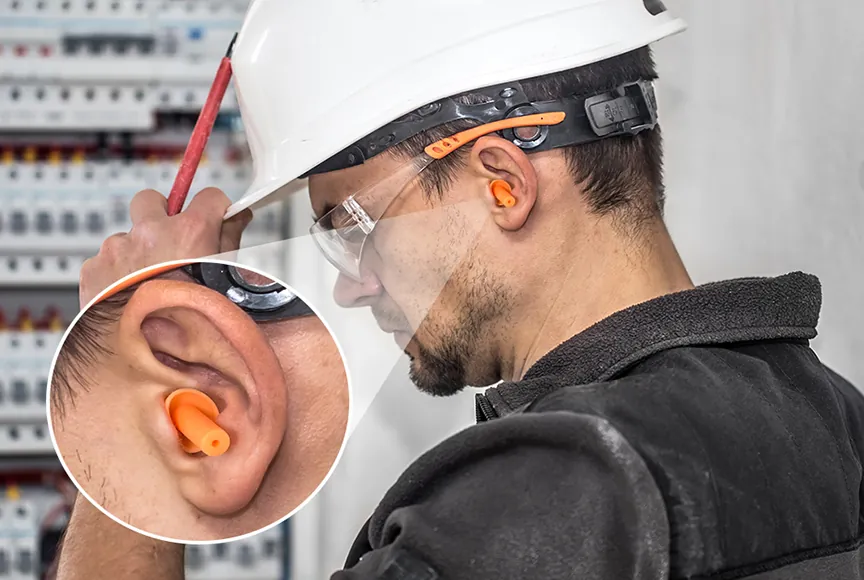
Three SKUs, two product types
Search this catalogue for industrial hearing protection and three SKUs come back: SA-8-11, SA-7-5 and SA-1-3. One is a passive earmuff and two are earplugs, which is a larger difference than the category label suggests. An earplug has to fit a canal. An earmuff has to seal around it. The earmuff line carries no size field at all - SA-8-11 is an ABS shell for adult wearers, and the attribute sheet stops there and moves to colour.
The three also inherit different family defaults, and those defaults decide the commercial shape of an order. SA-7-5 is PU foam: 2,000 pairs minimum, customisation from 30,000 pairs, packed 60 pairs to a jar, 5 pairs to a box or 1 pair to a box. SA-1-3 is silicone: the same 2,000-pair minimum, customisation from 20,000 pairs, one pair in a plastic box. SA-8-11 is the earmuff: 50 sets minimum, customisation from 500 sets.
The label needs one caveat. The foam family records sleeping, travel and industry as its application scenarios on a single line, so all seven foam SKUs inherit the industrial tag regardless of size or rating - SA-7-10 at 26 dB carries it as readily as SA-7-5 at 38 dB. The silicone family records swim, bath and shower instead, so SA-1-3 does not carry the tag at all, even though this site files it under industrial. Treat the tag as a description of the family, not as a shortlist.
Where the attenuation ladder actually ends
Across the whole catalogue, SNR runs from 9 dB to 38 dB. The industrial three sit near the top: SA-1-3 at 29 dB, SA-8-11 at 31 dB and SA-7-5 at 38 dB. That 38 dB is the highest figure recorded anywhere in the range, and it is shared with SA-7-3, a 14 x 26 mm foam plug listed for adults with long ear canals.
Each of the three reaches its number by a different route, which is what stops them being interchangeable. SA-1-3 is a flanged silicone plug - 12.5 mm bottom flange, 8 mm top flange, 32 mm tall - in conventional and fully fumed silicone. SA-7-5 is a 13 x 24 mm foam plug that expands to fill the canal. SA-8-11 is a shell that seals against the side of the head. A buyer choosing between a 38 dB plug and a 31 dB muff is choosing a form factor with an attenuation figure attached, not two versions of one product.
One thing the sheets do not state: the test method behind each SNR value. The number is recorded per SKU; the standard is not. For a tender or a workplace programme, ask for the report behind the figure, per SKU rather than per family, before either number goes into a document.
A 50-set minimum and the customisation step
Fifty sets is the outlier in this catalogue. The lowest pair-based minimum anywhere in the range is 100 pairs; the foam and conventional silicone families start at 2,000. Against that, fifty sets is a fortieth of the commitment a foam trial needs, and what it buys is a durable ABS earmuff rather than a single-use foam plug - so a first order can be small and still put a product on a shelf.
Customisation moves in the same direction, but not at the same rate. Earmuffs go custom at 500 sets, ten times their own minimum. Foam goes custom at 30,000 pairs, fifteen times its minimum, and conventional silicone at 20,000 pairs, ten times its own. A customised earmuff order is therefore reachable at a quantity that would not yet unlock a customised foam plug. If a range needs its own colourway before it needs volume, this is the line where that happens first.
It is worth sequencing rather than absorbing the whole commitment at once: fifty sets to test, a repeat order once sell-through is visible, and the customisation conversation only when the order clears 500 sets. Nothing in the catalogue requires all three decisions on the same day.
Cartons: what is recorded and what is missing
Freight on this category is set by two lines that do not move with the MOQ: carton dimensions and gross weight. SA-8-11 ships one set per box in a carton of 40 x 34 x 53 cm at 7.4 kg gross. SA-7-5 uses the same 40 x 34 x 53 cm footprint, but the sheet records 3.55 kg.
The rest of the foam family defaults to 42 x 35 x 44 cm at 9.0 kg, and the silicone family carries the same 42 x 35 x 44 cm at 9.0 kg. SA-7-5 is the only foam SKU that overrides its family carton, so a mixed foam order can arrive in two carton specifications from the same family, one of them 5.45 kg lighter. If inbound freight is quoted per carton, that difference belongs in the landed cost before it reaches a customer.
Then the gap. SA-8-11 records a carton size and a gross weight but not how many sets that carton holds. The two baby earmuff SKUs in this catalogue do state it - SA-8-9 at 24 sets per carton, SA-8-12 at 60 - so the figure is obtainable. Ask for it for SA-8-11 specifically. Without a set count you can cost the weight of a shipment but not the units per pallet, and cost per set stays an estimate.
Colour, packaging and the RFQ checklist
Colour is where the industrial line separates itself most clearly. SA-8-11 offers black, fluorescent orange and fluorescent lemon - the only fluorescent colourways anywhere in the catalogue of 28 products. If the range has to read as site equipment at arm's length, this is the SKU carrying that signal, and no other product here offers it.
The plugs are tighter. SA-1-3 comes in orange and yellow only. The foam family runs orange, blue, green and yellow, or to your requirements, and it is the line where colour and packaging are decided together: 60 pairs to a jar, 5 pairs to a box, or 1 pair to a box.
Before the enquiry goes out, six details are worth fixing in writing:
- SKU and rating together - a 38 dB foam plug and a 31 dB earmuff are different products, not two prices for one specification
- Colour, per SKU: the three lines use different colour vocabularies, and only the foam line accepts colours to your requirements
- Packaging configuration - jar, 5-pair box or single-pair box for foam; plastic box for SA-1-3; one set per box for SA-8-11
- Carton dimensions and gross weight, including SA-7-5's 3.55 kg carton against the family default of 9.0 kg
- Sets per carton on SA-8-11, which the attribute sheet does not record
- The test report behind each SNR figure, per SKU rather than per family
Four of those six can be answered from this page. The last two - sets per carton and the standard behind the rating - are factory questions, and both change what the goods cost landed. Put them in the first email, not the third.